Ocean Shells Vector Pattern: Designs for Modern Projects
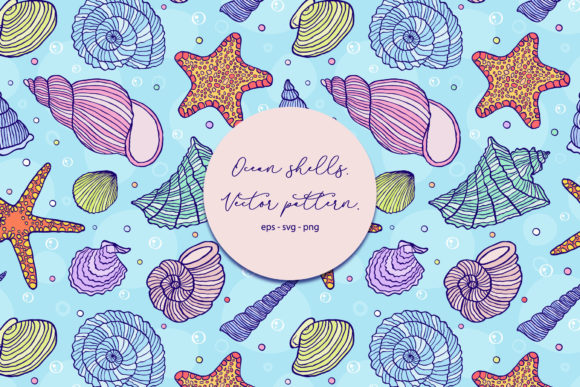
You might notice a set of shell illustrations arranged in repeating tiles and wonder whether it can serve a serious purpose beyond holiday scrapbooking. Ocean Shells vector patterns are precisely that—seamless, scalable motifs built from clean linework and gentle shell silhouettes, ready to slip into branding, packaging, editorial design, or digital content. Because they live in formats like AI, EPS, or SVG, every curve remains sharp at postage-stamp size and on large-scale murals. This flexibility, paired with the calm rhythm of coastal imagery, makes the pattern a quietly powerful tool for anyone who needs to finish a project faster, communicate a certain mood, or just avoid staring at a blank canvas.
Why Scalable Shell Motifs Solve Real Design Problems
Vector patterns eliminate a handful of workflow friction points that raster images introduce. When you drop an Ocean Shells vector pattern into a document, you are working with mathematical paths rather than pixels. The immediate benefit is resolution independence; you can enlarge a single tile to cover a wall graphic or shrink it to line the inside of an envelope without losing crispness. For small business owners who hand off artwork to different printers, this means one file works for everything—shop window decals, thank-you cards, and social media banners—without re‑exporting at different sizes.
The pattern format also keeps file weights surprisingly low. A complex shell illustration might look intricate, but as a repeatable vector it often consumes fewer megabytes than a high-resolution JPEG. That matters when you are building a responsive website, creating an email newsletter with a decorative background, or sharing working files with a team. Marketers and bloggers who load a subtle shell backdrop onto a landing page can preserve fast load times while adding visual texture that makes a page feel less generic.
Beyond technical efficiency, the built-in repetition saves creation time. Instead of drawing or sourcing individual shell graphics and aligning them by hand, you apply a single tile and let the repeating logic do the heavy lifting. Creators who assemble digital planners, habit tracker templates, or print-on-demand products can fill dedicated areas with a seasonal motif in seconds—leaving more time for layout refinements and less for manual duplication.
Creative Uses That Reach Beyond Beachy Vibes
The obvious application sits with coastal brands, marine conservation campaigns, or summer event collateral. Yet limiting the pattern to surf‑shop aesthetics bypasses much of its versatility. When you treat the pattern as a neutral organic texture—scaled down, recolored, or overlaid with a low opacity—it turns into a soothing background for spa menus, counseling center brochures, or mindfulness app interfaces. The soft, rounded forms echo natural geometry without yelling “hello, tropics.”
Entrepreneurs designing product packaging often find that a understated shell repeat adds a tactile, heritage quality. A white-on-cream version printed on a recycled paper box suggests artisanal soap or skincare. A single‑color navy version on a cotton tote bag flirts with nautical nostalgia without becoming a cartoon. Because vector colors are editable at the path level, you can match the shell tint precisely to a brand palette—no color‑matching guesswork required.
Educators and content publishers equally benefit. A downloadable worksheet with a faint shell border turns a math drill into something approachable, while a presentation slide deck for a marine biology talk gains visual weight from a consistent motif without stealing attention from data. The pattern also slides comfortably into digital products: iPad wallpaper sets, Etsy printable bundles, or Canva brand kits for wellness coaches. In all these cases, the vector nature means the motif remains crisp on screens of varying pixel densities.
Who Gains the Most from Ocean Shells Vector Patterns
A handful of readers will immediately see the practical value:
- Small business owners and product designers who need affordable, ready‑to‑customize visual assets for labeling, hang tags, and packaging without commissioning custom illustrations for every new SKU.
- Bloggers, journalists, and content marketers who publish frequently and want a reusable, on‑brand decorative element that ties articles together visually without requiring a new photo shoot each time.
- Freelance graphic designers and agencies who build client workbooks, pitch decks, and social media templates; a high‑quality vector shell pattern can serve multiple client projects when recolored and rescaled, improving margin per hour.
- Hobbyists and crafters who sell printable art, card designs, or cut‑file projects—vector patterns give them a foundation to create new listings quickly with a consistent, polished look.
- Educators and non‑profit communicators preparing classroom decorations, event flyers, or donor‑facing reports; a calm seaside motif can soften formal documents and make information feel more accessible.
Practical Outcomes You Can Expect
Using an Ocean Shells vector pattern well not only speeds up layout work; it also nudges the viewer toward a specific emotional response. A repeated shell pattern often carries connotations of tranquility, travel, or timelessness—associations that can bolster a brand’s story when aligned thoughtfully. For a therapist opening a private practice, the pattern on a website header or appointment card might subtly communicate safety and natural rhythm. For a beachside café, the same motif on a menu and loyalty card reinforces the overall dining experience.
Decision‑making becomes easier because you are working with a predetermined, repeatable visual system. When building out a product line, you can scale the pattern to different proportions and apply it across all touchpoints—thank‑you cards, shipping inserts, social media highlights—creating a cohesive look without endlessly hunting for new assets. Consistency, when done tastefully, helps customers recognize and remember you faster.
Efficiency gains are real and measurable. Rather than spending an afternoon sketching seashells or filtering stock libraries with inconsistent style, you can allocate that time to strategy, client communication, or just the next creative challenge. The vector format also makes future editing painless. Need the same pattern in a darker hue for a seasonal campaign? Adjust the global color swatch once and the entire tile updates. That kind of non‑destructive flexibility directly protects your investment of time and money.
Choosing the Right Shell Pattern: Fit and Considerations
As useful as these assets are, they are not a universal solution. An Ocean Shells vector pattern clearly leans organic and coastal, which might feel off‑brand for a tech firm, a law practice, or a corporate finance newsletter—unless intentionally paired with a modern geometric twist or used in extremely small doses. Before purchasing or downloading, ask whether the pattern’s inherent mood supports your message or distracts from it.
Licensing is equally important. Some free or low‑cost vectors come with restrictions on commercial use, print‑run limits, or attribution requirements. If you plan to apply the pattern to merchandise you sell, confirm you hold the appropriate license. Premium marketplaces often include an extended license that covers product‑for‑sale scenarios, giving you peace of mind. Spending a few extra minutes upfront avoids headaches later.
Technical compatibility can also trip up newcomers. While industry‑standard tools like Adobe Illustrator handle vector patterns natively, some web‑based editors treat them as fixed‑size images unless you export a high‑resolution raster copy. If your workflow lives entirely inside Canva or similar platforms, consider importing the pattern as a high‑resolution PNG at the largest expected size. It will not be infinitely scalable, but for many digital projects it works acceptably. For best results, however, keep the original AI or SVG file on hand so you can always go back to the source when needs change.
Integrating the Pattern into Your Daily Workflow
Start small to understand how the motif behaves in different contexts. Apply the pattern to a watermark, a section divider in a newsletter, or the background of a quote graphic. Experiment with scaling: a tiny shell repeat can read as subtle texture, while an oversized version turns abstract and graphic. Pairing the pattern with modern sans‑serif type often balances its organic feel and updates the look for contemporary audiences.
If you serve clients, showcase how adaptable the pattern can be. Present it alongside a minimal logo, a bold color block, and plenty of negative space. Demonstrate that a design asset tied to “shells” can feel sophisticated—especially when printed on a matte stock, debossed on a leather product, or used as a monochrome element in a presentation.
Remember that the pattern itself is a starting point, not a finished design. Layer it with other vector elements—borders, abstract shapes, or hand‑lettering—to create something distinctly yours. That way, even if other businesses use the same base asset, your final execution remains unique through color choices, composition, and supporting visual language.
Long‑Term Value for Creators and Communicators
A well‑chosen vector pattern often earns its keep over many years and multiple projects. When you find an Ocean Shells design that aligns with your aesthetic, it becomes a reusable texture in your toolkit. You might repurpose it across seasonal campaigns, annual events, and evergreen content, amortizing the initial cost into negligible fractions per use. Creators who build brand collaterals for multiple clients may also recycle the pattern with modified colors and placements, turning a single asset into diverse deliverables.
From a learning standpoint, dissecting how the pattern is constructed can improve your own vector skills. Opening the original file to study the control points, tile alignment, and clipping masks gives you insights you can apply when building your own repeat patterns from scratch. That educational value adds another layer of return for designers and hobbyists keen to advance their craft.
Whether you are designing a product label, refreshing a blog layout, or putting together a presentation that needs a hint of warmth, Ocean Shells vector patterns offer an efficient marriage of nature‑inspired form and technical reliability. By understanding what the format does well, respecting its limitations, and applying it with intention, you gain a resource that quietly supports your work—without demanding the spotlight.