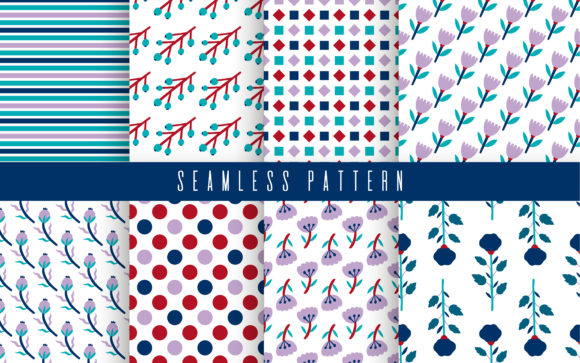
What Is a Pattern Set Flower—and When Does It Fit Your Project?
A Pattern Set Flower is a structured visual or conceptual framework used to organize, represent, and explore recurring design motifs—especially in textiles, surface pattern design, architectural ornamentation, and digital asset creation. Unlike a single repeating tile or isolated motif, a Pattern Set Flower groups related patterns into a cohesive family: often including a central motif (the “bloom”), supporting borders, coordinating allover repeats, tonal variations, and sometimes directional or scale-shifted derivatives. The term “flower” reflects both the radial arrangement of these elements and the organic way they branch from a shared root idea—color palette, botanical inspiration, geometric logic, or cultural reference.
How It Differs From Other Pattern Organization Methods
Many designers work with pattern libraries, swatch books, or digital asset folders—but those are typically storage systems, not intentional frameworks. A Pattern Set Flower goes further: it embeds relational logic. For example, a floral-themed Pattern Set Flower might include a large-scale damask as its central motif, paired with a narrow vine border, a small-scale dot repeat using the same stem color, a monochrome version for subtle backgrounds, and a high-contrast variant for focal panels. Each piece is designed to coexist, not just coexist in a folder.
This contrasts with:
- Standalone pattern files: Individual .png or .ai files with no built-in compatibility guidance. You can use them together, but alignment in scale, rhythm, or tone isn’t guaranteed without manual adjustment.
- Pattern collections sold as bundles: Often grouped by theme or vendor, but rarely engineered as interlocking parts. One may feature bold outlines while another uses soft watercolor edges—making visual harmony depend on your editing skill, not the set’s design intent.
- Algorithmic pattern generators: Tools that produce infinite variations on a prompt. They offer flexibility but lack curated intentionality—no built-in hierarchy, no deliberate contrast balance, and no assurance that variants will scale or recolor consistently across formats.
The Pattern Set Flower bridges intention and utility. It assumes you’ll need multiple pattern types for a real-world application—say, a textile line for home goods—and builds compatibility into the foundation.
Strengths: Where It Adds Clear Value
The primary strength lies in cohesive scalability. If you’re developing a product range—like a capsule collection of napkins, tablecloths, and cushion covers—a Pattern Set Flower ensures every item feels part of the same world, even when using different pattern types. Designers report spending 30–50% less time adjusting contrast, reworking scale relationships, or testing color fidelity across applications when starting from a Pattern Set Flower rather than disparate assets.
It also supports iterative development. Because variants are conceived as branches—not afterthoughts—you can test one element (e.g., the border) independently and know how changes ripple across the set. A shift in stroke weight on the vine motif automatically informs adjustments in the dot repeat’s spacing or the damask’s line density.
For educators and students, Pattern Set Flowers serve as pedagogical anchors. Instead of teaching pattern-making as isolated techniques (e.g., “how to create a half-drop repeat”), they model how decisions in one area affect others—helping learners grasp hierarchy, restraint, and systemic thinking.
Tradeoffs and Practical Limits
A Pattern Set Flower requires more upfront design time. Creating five coordinated variants with intentional scale ratios, consistent line weights, and harmonized color behavior isn’t faster than exporting one repeat—it’s slower initially. That investment pays off only if you plan to use multiple pieces together, or intend to extend the set later.
It also assumes a degree of design fluency. Someone new to repeat construction or color theory may find the interdependencies overwhelming at first. There’s little room for arbitrary swaps: replacing the central motif without recalibrating supporting elements often breaks the set’s internal logic.
And unlike modular systems built for maximum interchangeability (e.g., SVG-based pattern kits with adjustable parameters), a Pattern Set Flower is purposefully bounded. It doesn’t aim to be infinitely extensible—it aims to be *sufficient* for a defined scope. That focus is a strength in context, but a limitation if your needs evolve toward maximal flexibility.
Fitting It Into Real Projects: Use Cases and Mismatches
Consider a Pattern Set Flower when:
- You’re launching a limited-edition fabric line with three SKUs: a main print, a coordinate solid (with subtle texture), and a narrow trim. A Pattern Set Flower gives you all three, pre-validated for visual cohesion.
- Your client needs branding assets that extend beyond logos—wallpaper for their office, packaging wrap, and presentation deck textures—all drawing from the same visual DNA. A Pattern Set Flower delivers scalable, on-brand texture options without requiring custom illustration for each surface.
- You’re designing for production constraints (e.g., screen-printed textiles with max 8 colors). A Pattern Set Flower developed within that limit ensures every variant respects the same palette and layer count—no last-minute color reduction surprises.
It’s less suitable when:
- You need one-off, highly specific patterns—for example, a custom repeat matching exact brick dimensions for a façade rendering. A Pattern Set Flower’s emphasis on family logic may over-constrain such a precise, singular requirement.
- Your workflow relies heavily on real-time customization (e.g., generating unique patterns per user via web app). Pattern Set Flowers are static by nature; they don’t adapt dynamically unless embedded in a larger system.
- You’re working under tight deadlines with minimal revision cycles. The upfront coordination effort may delay initial delivery—even if it saves time downstream.
How to Evaluate Whether It Fits Your Workflow
Ask yourself three questions:
- Do I routinely need multiple related patterns—not just one—for a single project? If yes, consistency labor adds up quickly without a unifying structure.
- Is visual hierarchy or intentional contrast part of my design goal? Pattern Set Flowers encode those relationships explicitly—e.g., “this border recedes so the central motif advances,” or “this variant desaturates to function as background.”
- Will others use or extend this work later? A well-documented Pattern Set Flower includes usage notes, scale references, and color definitions—making handoff clearer than a folder of unnamed files.
If two or more answers are “yes,” a Pattern Set Flower likely improves efficiency and outcome quality. If not, simpler organization methods may serve you better.
Looking Beyond the Set: Integration With Broader Systems
A Pattern Set Flower doesn’t exist in isolation. It works best when aligned with broader design systems—color palettes with defined roles (primary, accent, neutral), typography hierarchies, and image treatment guidelines. Think of it as the *textural layer* of a system: adding richness without competing with other elements.
Some teams integrate Pattern Set Flowers into Figma or Adobe XD design systems as reusable components—with linked variants, naming conventions like Flower-Bloom-Main, Flower-Border-Narrow, and metadata tags for scale and application. Others treat them as living documents, updating the set as new production techniques emerge (e.g., adding a metallic-ink variant when moving from digital to foil-stamped packaging).
What matters isn’t whether you adopt the term “Pattern Set Flower,” but whether your process intentionally connects pattern choices—not just stores them. The name is a shorthand for a mindset: that patterns gain meaning through relationship, not just repetition.